Friday, February 6, 2015

A 45 Minute Conversation With a Congressman


As a public school teacher wouldn't you just love to have a sit down conversation with your Congressman and have the chance to tell them what's up with education?  I had this opportunity to do just that with Rep Bill Posey of Florida's 8th Congressional District, who sits on the House Science and Technology Committee.

Funny story was the meeting ended up being scheduled after I was already planning to be on Capitol Hill that morning attending the STEM Diversity Symposium.  Fortunately for me, both were in the Cannon House Office Building.

Sorry to leave you Grant, but I have an 11 O'Clock with the Congressman.

Meeting Grant Imahara of MythBuster's Fame.  Was the first selfie I ever took and unfortunately it shows.
The STEM Diversity Symposium was tremendous.  I arrived early and was fortunate to be able to meet and talk with Grant Imahara for a few moments.  Basically telling him that I was an engineering technology teacher and that his work on MythBusters went a long way in inspiring youth to pursue the field.

I saw another very familiar face  - Hakeem Oluseyi the Astrophysicist from FIT and Science Channel Host of the series Outrageous Science, was also in attendance.  For years I had taken my STEAM Academy students to FIT's Laser Day event and had on many occasions sat in on discussions with Hakeem about Black Holes, Dark Energy/Matter, Star Trek physics, and the like.

Congressman Posey

When I was contacted by Rep Posey's office to schedule the meeting I was asked to prepare a brief of the things that I would like to discuss during our time together.  This activity taught me how valuable getting your thoughts together on paper is... I also came to realize in my work with NSF and other prominent agencies that it is the secret behind how highly educated people are able to turn that amazing phrase or make a really strong point... they are just quoting themselves from the briefs, abstracts, and reports that they have previously written.
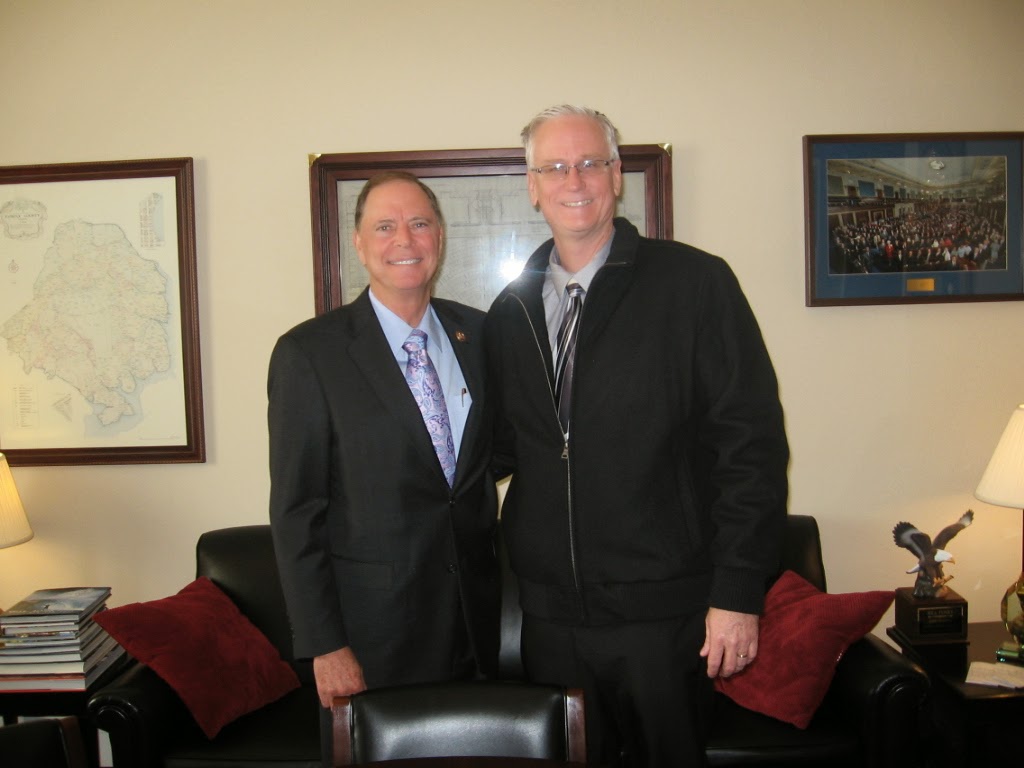
Congressman Posey was very generous with his time and we had a very good discussion over the troubles in the North Area of Brevard County with the demise of the Shuttle Program.  The resultant effects from losing so many students and the brain drain from the area as technical, engineering and leadership professionals left the Space Coast.  The impact was significant on our schools as these professionals were the very backbone of Brevard County's great tradition of our students doing so well in science and engineering contests.  How for example, our high school's FIRST Robotics Team had to fold into another team due to the fact that we could no longer get sufficient engineering mentor support.


Big Three Issues Confronting Educators Today:

1.  What is the Overall State of Education and Ed Reform?
There is ongoing effort that is seeking to standardize educational content, delivery methodologies, and teacher evaluations with initiatives like common core, Next Generation Science Standards, and Race to the Top.  While certainly not everything put forth in these programs is without merit, they are largely proposed as a knee jerk reaction to the US continually getting their butts kicked internationally in standardized testing, and they are highly disruptive to other more essential elements of education that are suffering as a result.

China actually Singapore (which is the Chinese equivalent to the Boston educational community of Harvard and MIT), just ended up on top again in math and science but surprisingly they still are not excited about the results. This is a really curious reaction and the reason they feel this way about the testing results is because nationally, they have yet to enjoy a “Steve Jobs moment.” That is to say that they are still waiting for a revolutionary entrepreneur to emerge from China.  (See Yong Zhao video from the ISTE Conference San Diego, CA (2013). Scrub to about 5:20 and watch him talk about standards).


https://www.youtube.com/watch?v=ijSxt94vhf0

YouTube video:ISTE 2012 Tuesday Keynote Featuring Yong Zhao Trim” YouTube video, 53:38.  Posted by "Gord Holden," July 2, 2012.  

This quote from Kai-fu Lee, a Chinese venture capitalist, is also appropriate to the discussion: “The next Apple or Google will appear, but not in China...unless it abolishes its education [system].”

Interesting it is that China, while sitting at the top of the standardized testing educational heap, is looking to totally reform its educational system to be more like the American Educational System in an effort to cultivate creativity and entrepreneurship. The results of the PISA Math Scores are very instructive when compared with international entrepreneurialship quotients:
 
This is a stunning graphic showing the reverse corollary of standardized test scores to creative and entrepreneurial ability


The PISA Test measures critical thinking in math, science, and reading across 65 countries, and is designed to be demographically neutral, meaning it doesn’t care about culture, student grade level, socio-economic factors, or achievement level. It is simply an apples-to-apples comparison of 15 year olds and their problem solving ability. Given the data from the chart above, it is clear that PISA scores have a negative corollary to creative and entrepreneurial ability.

In June of 2013, the Chinese Ministry of Education launched a major reform effort to de-emphasize the importance of testing.  The following criteria are now to be used to change the way their schools are evaluated:
  1. Transparent admissions. Admission to a school cannot take into account any achievement certificates or examination results. Schools must admit all students based on their residency without considering any other factors.
  2. Balanced Grouping. Schools must place students into classes and assign teachers randomly. Schools are strictly forbidden to use any excuse to establish “fast-track” and “slow-track” classes.
  3. “Zero-starting point” Teaching. All teaching should assume all first graders students begin at zero proficiency. Schools should not artificially impose higher academic expectations and expedite the pace of teaching.
  4. No Homework. No written homework is allowed in primary schools. Schools can however assign appropriate experiential homework by working with parents and community resources to arrange field trips, library visits, and craft activities.
  5. Reducing Testing. No standardized testing is allowed for grades 1 through 3; For 4th grade and up, standardized testing is only allowed once per semester for Chinese language, math, and foreign language. Other types of tests cannot be given more than twice per semester.
  6. Categorical Evaluation. Schools can only assess students using the categories of “Exceptional, Excellent, Adequate, and Inadequate,” replacing the traditional 100-point system.
  7. Minimizing Supplemental Materials. Schools can use at most one type of materials to supplement the textbook, with parental consent. Schools and teachers are forbidden to recommend, suggest, or promote any supplemental materials to students.
  8. Strictly Forbidding Extra Classes. Schools and teachers cannot organize or offer extra instruction after regular schools hours, during winter and summer breaks and other holidays. Public schools and their teachers cannot organize or participate in extra instructional activities.
  9. Minimum of One Hour of Physical Exercise. Schools are to guarantee the offering of physical education classes in accordance with the national curriculum, physical activities and eye exercise during recess.
  10. Strengthening Enforcement. Education authorities at all levels of government shall conduct regular inspection and monitoring of actions to lessen student academic burden and publish findings. Individuals responsible for academic burden reduction are held accountable by the government. 
Zhao, Yong. “Green Evaluation: China’s Latest Reform to De-emphasize Testing.” June 24, 2013.  http://zhaolearning.com/2013/06/24/green-evaluation-china%E2%80%99s-latest-reform-to-deemphasize-testing/


China wants to be like America and America wants to be like China 
- What Do You Want US to be Like?

So while America is trying desperately to compete internationally on the standardized testing front with countries like China, China is trying desperately to learn to educate its students the way we do it in America. Both countries are reforming the educational process – America toward more standards, content, more students stress and lower confidence levels and China, to fewer standards and less content, to lower student stress and increased confidence levels.  To this end the following points are salient:
  1. The current education reform efforts that attempt to provide a common, homogenous, and standardized educational experience, e.g., the Common Core Standards Initiative in the U.S., are not only futile but also harmful to preparing our children for the future.
  2. Massive changes brought about by population growth, technology, and globalization not only demand but also create opportunities for “mass entrepreneurship” and thus require everyone to be globally minded, creative, and entrepreneurial. Entrepreneurship is no longer limited to starting or owning a business, but is expanded to social entrepreneurship, policy entrepreneurship, and intrapreneurship.
  3. Traditional schooling aims to prepare employees rather than creative entrepreneurs. As a result the more successful traditional schooling is (often measured by test scores in a few subjects), the more it stifles creativity and the entrepreneurial spirit.
  4. To cultivate creative and entrepreneurial talents is much more than adding an entrepreneurship course or program to the curriculum. It requires a paradigm shift—from employee-oriented education to entrepreneur-oriented education, from prescribing children’s education to supporting their learning, and from reducing human diversity to a few employable skills to enhancing individual talents.
  5. The elements of entrepreneur-oriented education have been proposed and practiced by various education leaders and institutions for a long time but they have largely remained on the fringe. What we need to do is to move them to the mainstream for all children.


the more successful traditional schooling is (often measured by test scores in a few subjects), the more it stifles creativity and the entrepreneurial spirit. 


 ...innovation, creativity, and entrepreneurship are largely missing not only from the Chinese culture, but Asian cultures generally, due to the mechanical nature of their “efficient” schools. ...schools that emphasize content and standards at the expense of student autonomy, confidence levels, and happiness. 


Ironic it is then, that America has the creativity and entrepreneurship quotients and are moving to sacrifice them for higher test scores...


Foroohar, Rana. “China: Just as Desperate for Educational Reform as the US.” The Curious Capitalist.  Time Magazine – Business & Money. July 27, 2013. http://business.time.com/2013/06/27/china-just-as-desperate-for-education-reform-as-the-u-s/


Xueqin, Jiang. “How China Kills Creativity.” The Diplomat. July 2, 2011.


Rotherham, Andrew, J.  “Shanghai Surprise:  Don’t Sweat Global Test Data.” Time Magazine – US. 


2.  What Can be Done to Better Support our Teachers?

Teachers are an essential element of our society and no educational reform that does not recognize the teacher as the most important factor beyond a student’s own desire to learn will be effective.  High performing schools recognize this:

“You see so many teaching techniques that you can apply to your own classroom,” he remarks. Education experts will tell you that of all the things that go into improving a school, nothing — not class size, not technology, not length of the school day — pays off more than giving teachers the time for peer review and constructive feedback, exposure to the best teaching and time to deepen their knowledge of what they’re teaching.”

Friedman, Thomas.“The Shanghai Secret.” New York Times. Oct 22, 2013.

...
"Nothing - pays off more than giving teachers the time for peer review and constructive feedback, exposure to the best teaching and time to deepen their knowledge of what they’re teaching.”  


What NOT to Do:

The problem is that many of the reform measures, beyond what has already been delineated above are built on a faulty set of premises that appear to suggest that:

We should treat teaching as a mechanical process.  If we identify all the standards, show teachers how we want the standards taught, test students on these standards and then evaluate the teacher’s effectiveness by how well the students performed on the test, we will have an effective educational model. 

We should treat schools like a business, where we can use a return on investment (ROI) model.  We can improve teacher effectiveness and student learning by using external motivators such as “pay for performance”, or by punitive measures, such as comparing teachers against one another, publishing test scores of competing faculty, or the abolishment of teacher tenure where teachers have to vie for their teaching positions based upon their yearly evaluations.

What We SHOULD Be Doing:

In response to these assumptions I would submit the following suggestions to support teachers and teaching:

We Should Treat Teaching as a Creative Process 
not a Mechanical One.    


      What the standards and common core people fail to recognize is that teaching is a creative process, not a mechanical one. Master teachers have the innate ability to deal with an unrealistic and dynamic set of variables in a classroom to affect real learning in an almost superhuman way.

Recognize what the Standardization Movement's 
End Game is and Thwart all Efforts to 
De-professionalize Education.   

The end result of the standardization movement is nothing less than the de-professionalization of teaching and teachers.  Somehow the thought persists that there is some secret formula that we just haven't found yet. If we treat education like a mechanical process and just get the recipe right, create the proper script, anyone can teach and all students will learn. The simple fact is that teaching cannot be distilled into a formula that once identified, anyone can do.


YouTube video:  “Ken Robinson:  How to escape education’s Death Valley.” TED Talks Education. May 2013.

Some people can't seem to get away from this idea that education can be treated like a business and there needs to be ROI model. The problem is you can't improve education without allowing teachers to be creative and do what they do best, and not everyone can teach (as we all know only too well). 

The business model which is used to incentivize performance doesn’t even work in today’s businesses, much less in education.  As more and more companies are coming to understand, extrinsic motivators are not appropriate in 21st century problem solving - there are just too many variables.  The more complex a task is, the less effective performance incentives become, and in some cases, there is actually a negative corollary.  

 The more complex a task is, the less effective performance incentives become, and in some cases, there is actually a negative corollary.  This is one of the most robust findings in social sciences, and also, one of the most ignored.” Pink, (2013).

The problem solving of today calls for divergent thinking, thinking on the fringes and in places that are not obvious.  Answers to today’s problems are not found in expected forms and places, and they are actually quite surprising in their origins when viewed in hindsight.   

Simply put, incentivizing work causes workers to focus. Focus causes a narrowing of thought and of possible solutions to a problem and does not provide for the breadth of solutions needed for today’s workplace. It is for these very reasons that Apple, Google, and many other tech giants have abandoned this outdated corporate model.

Motivation research is showing that intrinsic motivation is by far the most powerful, this is because they contain three key elements: Autonomy/Mastery/Purpose.

Autonomy is the natural human desire to direct our lives.  Every human craves this opportunity and to the extent that they have autonomy will determine how happy they are.


Mastery is the human desire to become really good at something that adds value to society.


Purpose is the human yearning to be a part of something that is larger than yourself.  Helping others, building community, and solving problems.

Successful companies are learning that to create an affective, highly motivated workforce, each of these elements must be cultivated and given opportunity to develop fully.  What is perhaps not so well recognized is that the elements of Autonomy/Mastery/Purpose are perfect job descriptors of the teaching profession in its truest state.  To the extent that any reform measures impact on these elements is severely damaging to the teaching profession.


YouTube video:  Pink, Daniel:  “Drive: The Surprising Truth about What Motivates Us.”


Many administrators don't understand a simple concept: Creating an environment where teachers thrive creates an environment where students thrive. Best performing schools/districts have largely abandoned the performance review process. Once a teacher has demonstrated teaching mastery and is highly qualified, effective administrators largely leave them alone to teach and these teachers don't have to continually prove their worthiness year after year. This leaves administrators and master teachers free to support struggling teachers.

Creating an environment where teachers thrive creates an environment where students thrive.

“Shen Jun, Qiangwei’s principal, who has overseen its transformation in a decade from a low-performing to a high-performing school — even though 40 percent of her students are children of poorly educated migrant workers — says her teachers spend about 70 percent of each week teaching and 30 percent developing teaching skills and lesson planning. That is far higher than in a typical American school.” (Friedman, New York Times, Oct 22, 2013).


3.  What challenges do our teachers face implementing STEM?

“The STEM crisis has not occurred despite our best efforts in teaching math and science, it has occurred 
precisely because of it.”

When we continue to teach math and science skills in isolation it is just like learning a skill with no application. We must abandon the academic model of instruction in favor of more problem based contextual learning.  Simply put, there must be more emphasis on context and less emphasis of content for content's sake.

Students must learn and be introduced to material contextually. Contextual learning provides the best opportunity for our students to connect their skills with real world application and utility.  Our students are very familiar with this process as they continuously access information using their smart phones.  They do so by selecting, downloading and testing applications based upon their utility.  If an application does not have sufficient utility, the user deletes it in favor of a more effective app.  It is evident that our students are essentially doing the very same thing when we teach them academic skills in isolation.  By providing content without necessary context, students are not retaining academic skills notwithstanding our best intentions...  students are essentially"deleting the app" as soon as they can because it has no utility in their life.   


“Some educational theorists speculate that the reason most people forget their math lessons quickly is because they learn math in a single abstract medium.” 

(Lipson and Kurman. Fabricated: The New World of 3D Printing. 2013).

The 'T' and 'E' of STEM that is, the technology and engineering pieces, provides the context of learning math and science concepts.  Unfortunately when you look at many of the STEM models often what you see is more of the same - we call the delivery STEM but it is essentially the same academic package with just a different name.  In nothing is this more evident than the way districts attempt to address the technology piece of the STEM equation.  The technology piece simply cannot be satisfied by having students use iPads or laptops instead of textbooks - that is educational technology and not STEM Technology.

Technology and engineering are not just just additional subjects to be added to the academic mix, they are integrated members of the strategy - they are the context.  Technologies are the products of engineering design activity.  It goes without saying that if a STEM strategy is not making the requirement that students design, iterate, and create technologies as part of their program of study, they are simply not engaging in STEM.  

The biggest difficulty that I can see with enacting STEM Education programs is that many  professional teachers don't know how engineering skills are used in industry so they can’t relate them to their students or deploy them properly as part of an effective STEM strategy.


 The dirty little secret of an effective STEM program is that STEM Education is really an euphemism for WORKFORCE DEVELOPMENT.  Teaching our students necessary workplace skills, integrated, applied, and contextual, just as they are used in the real world, is the greatest possible outcome of the STEM Movement.


The fact that very few educators understand the engineering discipline and how to incorporate it into their instruction is a huge barrier to success because the Next Generation Science Standards mandate it:  "The next-generation science standards call for making science and engineering equal, but there are no science teachers today trained to teach science and engineering and, even more importantly, there are no professors of science education prepared to train teachers to teach science and engineering,"


“Lab school brings manufacturing technologies to middle-school classrooms.”
 

National Science Foundation Press Release 13-184. Oct 29, 2013.


There are very successful models across the nation that integrate academic instruction with an engineering CTE program to create effective STEM instruction. Such programs replicate engineering design activity through the use of project based learning (PBL) which naturally integrate STEM subjects: “...the STEM PBL challenges provide students with authentic real-world problems captured and re-enacted in a multi-media format designed to emulate the real-world context in which the problems were encountered and solved.” (Massa, DeLaura, Dischino, Donnelly, Hanes, 2012).


Anytime a teacher makes a requirement for students to learn, collaborate, or produce a project using the appropriate technology, they leverage the learning gains by not only providing learning content in a compelling way, but in the context of how it is used in the world. As we do this, we provide our students with the skill set for tomorrow’s workplace. That is the true charge of the STEM movement.


Saturday, January 24, 2015

A Short History of Math Instruction in the United States


By Stephen Portz
I remember growing through my public school days during the 60’s and 70’s and having the usual struggles with homework.  My father worked in the aerospace industry at Kennedy Space Center and was a whiz in math.  I would go to him for help with my math homework and he would check my arithmetic and would make things look so easy.  He actually thought stuff like that was fun!  I considered him a math god for his ability to do word problems and calculations so quickly in his head.  But as my program of study moved into the high school years and the math got less concrete and more abstract, dad was not able to help me anymore.  He would look over what I was supposed to do and then look at the sample problems and try to make reason of the assignment.  Invariably, he would shake his head and tell me that he couldn’t make sense of this “new math.” I remember thinking, “What the heck is this new math and how is it different than the old math?  I couldn’t do what my dad could do with numbers - he was pretty impressive and after all he was the proverbial rocket scientist, and if he couldn’t do it how could I ever expect to master it?”

“What the heck is this new math and how is it different from the old math?"

All of these concerns have stayed with me.  As a secondary school engineering technology teacher and as a parent that has tried to help my own children navigate through math classes, my curiosity about the impact that the changes in the math curriculum has had in our country persists.  More recent international tests (PISA) have revealed that whatever has been done of late to try to improve math education has been appalling ineffective as United States students scored 29th of the 65 countries tested.  Another troubling statistic is that the US has fewer high performing youth, just 2% of test takers as compared with about one third of all students in Singapore scoring as high performing.

While conducting this study in the evolution of math education, the thing that strikes me most is how often the educational “experts” have tinkered with educational philosophies, methods, and content down through the years.  There is a feeling of a constant state of flux and instability like some haphazard research experiment gone wild.  Who can calculate the effects that this experimentation has had on our country’s computational and competitive ability?  Educational Professor William Bagley from the University of Illinois, similarly lamented, 

“In no other country are the professional students of education so influential. In no other country is school practice so quickly responsive to the suggestions emanating from this group. We may stigmatize our schools as "static," "reactionary," "slow to change,"-- reluctant to adopt what we, in our wisdom, prescribe. But compared to other countries, ours is the “educational expert's” paradise."
 Quoted in Diane Ravitch, Left Back, p. 193.

The subject of math education in America has been so often debated, reformed, and repackaged in the educational community that all efforts to right the ship have commonly been referred to as the “math wars.” It may be supposed that math instruction, like many subjects, have proponents for certain methods as well as detractors for others, since its very inception.  

Even the celebrated physics icon Richard Feynman at one time waded into the fray, "If we would like to, we can and do say, 'The answer is a whole number less than 9 and bigger than 6,' but we do not have to say, 'The answer is a member of the set which is the intersection of the set of those numbers which is larger than 6 and the set of numbers which are smaller than 9' ... In the 'new' mathematics, then, first there must be freedom of thought; second, we do not want to teach just words; and third, subjects should not be introduced without explaining the purpose or reason, or without giving any way in which the material could be really used to discover something interesting. I don't think it is worth while teaching such material."
Richard Feynman 1965 essay "New Textbooks for the 'New Mathematics"


Although the new math movement was highly criticized and eventually discarded, it is interesting to note that it was the only time in our educational history that mathematicians, and not educators, actually wrote the curricular materials:
Mathematicians have agreed for years that emphasizing sets and number bases in math programs designed for the lower grades was a horrendous mistake. Notwithstanding these errors, however, the difference between the current slew of textbooks and those from the new-math days of the 1960s is definitely worth noting: Accomplished mathematicians wrote many of the texts used in that earlier era, and the math—though misguided and inappropriate for the lower grades and too formal for the high school grades—were at least mathematically correct. Some of the high school texts were absolutely first-rate, and new-math–era textbooks like Mary Dolciani’s “Structure and Method” series for algebra and geometry continue to be used by math teachers who understand mathematics and how it is to be taught. (They usually used them on the sly, since most teachers are required to use the books that the schools have adopted.)”
Some historical perspective is warranted here.  Prior to our country’s Sputnik moment, teacher’s education programs were mostly institutions that taught pedagogy, not subject area content.  The philosophy here being, that if you know how to teach students and you have a content textbook, then any material should be able to be taught by any certified teacher.  With regard to math instruction, this time period was distinctive in that leading math professors in the country were very vocal about the impropriety of teaching advanced math topics to the masses.  Prior to WWII less than 50% of students graduated from high school.  Students going on to college were in the low single digits and so the effort to teach everyone geometry, algebra and trigonometry was seen as foolishness because most students would never use the skills.

"With regard to math instruction, this time period was distinctive in that leading 
math professors in the country were very vocal about the impropriety of teaching 
advanced math topics to the masses."

During WWII, the academic competencies of the American GI were called into question by Admiral Nimitz.  At a time of great national security urgency, military recruits had to be trained in math to understand gunnery and logistics computations because their public school education was so poor.
http://www.math.cornell.edu/~henderson/courses/EdMath-F04/MathWars.pdf

After Sputnik was launched, Americans felt the schools were in crisis. Nikita Khrushchev famously banged his shoe on the desk at the United Nations and shouted “We will bury you!”  This of course prompted the ensuing rush to educate our students in the hard sciences.  The National Science Foundation (NSF), created in 1950 to promote basic scientific research, was expanded in 1957 and began to examine and promote change in secondary school education in math, biology, chemistry, and social sciences. The changes in the curricula and texts had a filter-down effect on the primary schools as well.

But the effort to have a large federal entity producing curriculum for the state educational systems and local school districts met with resistance.  Especially after the highly controversial MACOS curriculum was created and disseminated by the NSF in 1970.  This curriculum fell into disfavor because of the way it challenged students to think about belief systems and the way it questioned absolutes of morality.  The MACOS incident raised considerable suspicion about a strong central agency of the government using tax dollars for what some perceived as an indoctrination scheme.

 Mathematics presented a different situation. Mathematicians criticized the new programs because the content was too abstract and neglected significant applications; teachers criticized the programs because they were too difficult to teach; and, parents criticized the new math because they worried that their children would not develop fundamental computational skills. The movement had a far reaching effect, in the academic year 1976/77 almost 60% of school districts were using one or more of the federally funded programs in grades 7 through 12; and 30% of school districts reported using at least one program in elementary schools.

After a period of time the political clamor had died down and another crisis in education emerged with the 1980s report, “A Nation at Risk.”  Once again federal agencies were empowered to study and make recommendations for how to improve our nation’s schools. 

So the history of federal funding of curriculum has been a long on again 
off again study of agencies finding and then walking a fine line between 
rising to meet the security demands of our nation without prescribing content 
and methods which take away from the freedoms and powers of its citizenry.  

In 1989, the National Council of Teachers of Mathematics (NCTM) published its Curriculum and Evaluation Standards for School Mathematics—an extensive set of mathematics standards for grades K–12 which de-emphasized memorization of number facts, the learning of proofs, and algebraic skills, but encouraged the use of calculators and “discovery learning.”  Two years later, the NSF promoted the standard and awarded millions of dollars in grants to textbook writers who aligned with it, as well as the districts who adopted the new NCTM Standard.

This spiked an additional wave of controversy in math education which emerged in the 1990s prompting what President G W Bush would refer to as the teaching of “fuzzy math.”  Several of the methods that came out of NSF grant funding involved a de-emphasis of arithmetic computational skills by students, an increased use of calculators even in primary grades, and a notion that the teaching of efficient algorithms should take a back seat to students developing their own creative ways to solve problems in what is termed “discovery learning.” A telling quote from the book publisher states:

“The authors of Everyday Math do not believe it is worth the time and effort 
to develop highly efficient paper-and-pencil algorithms for all possible whole number, 
fractions and decimal division problems....It is simply counterproductive to invest 
hours of precious class time on such algorithms. The math payoff is not worth the 
cost, particularly because quotients can be found quickly 
and accurately with a calculator.”


Below is a flow chart of funding for the development of math education curriculum during the 1990s:


Pay particular attention to 1999 and beyond to understand the repercussions and fallout of these math policies...

To understand the public backlash against the NCTM math programs of the 1990s, one needs to understand some of the mathematical shortcomings of these programs. The mathematics books and curricula that parents of school children resisted shared some general features. Those programs typically failed to develop fundamental arithmetic and algebra reasoning skills. Elementary school programs encouraged students to invent their own arithmetic algorithms, while discouraging the use of the superior standard algorithms for addition, subtraction, multiplication, and division. Calculator use was encouraged to excess, and in some cases calculators were even incorporated into kindergarten lesson plans.

More recently, Senator Tom Coburn of Oklahoma introduced legislation to curtail NSF research that was viewed as wasteful use of taxpayer dollars.  This action specifically targeted research that can be construed as have political implications/motivations such as studies on voter patterns as well as other social science research, but it has had the effect of causing the agency to consider more carefully all the research that it funded and the way the public perceives the influence of the NSF.


The effect of this scrutiny has been to guard against what may be construed as undue influence.  As a result, the party line at the agency is that the NSF does not prescribe or dictate curriculum to the states.  But without question it definitely funds research in curriculum development to its surrogates such as the NCTM.  It is likewise disingenuous to portray these activities as non-influential to state and district educational bodies and textbook publishers as well.

Fast forward to Common Core Math Standards and much of the hullabaloo begins to have some context, like the road most traveled.
Some questions to consider going forward:
As we have seen through the years what certain "educational experts" have wrought and the result, what assurances does anyone have that this math makeover will be effective or at least less damaging than past efforts?
What standards and curriculum are used by high performing international programs?  Do the common core math standards use any elements of these successful models from around the world? 
Are high performing countries recognizing that the US has new math standards and are migrating to that as well because they are so good?  For example, the NCTM Math Standards from the 1970's were originally adopted by Israel but they abandoned them for the Singapore Standards.
As is frequently said, ad nauseum:  "the standards are not the curriculum" which is kind of like saying to a product designer the design specifications do not effect the design limits and constraints.  

Of course they do, unless perhaps you are applying a new math standard...


Sunday, January 4, 2015


Lessons From Miss America - It is Cool to be Smart!


By Stephen Portz 


Nina Davuluri was the first STEM graduate to be crowned Miss America.  During her reign as Miss America, Nina made it her priority to encourage STEM Education across our Nation.


I had the privilege of meeting Nina Davuluri this past summer in the House Science and Technology Caucus Room. She was meeting on Capitol Hill to talk about STEM education and she made a request to meet with the Einstein Fellows.  It was fabulous to meet her and discuss STEM Education, particularly as it applied to women and minority participation.
Nina Davuluri meeting with the Einstein Fellows to discuss STEM Education and broadening participation in the field.

I started off the question and answer portion of our meeting by asking Nina what it was about her background that made STEM interesting for her as a field of study?

She made three important points:

1.  "The high school that I attended had strong STEM academic course offerings.  We had AP physics, chemistry, calculus, statistics etc...  You could get through the school without taking those classes, but I wanted to challenge myself and see if I could do them."

2.  "I have parents that have high expectations of me.  If I came home with a 95% on a test, they would ask why I didn't get a 100%."

3.  "I had good friends.  We would hang out by studying and helping each other understand the work. I tutored other students who were struggling and it helped me understand the material better."

My next question was a little more pointed:  "As STEM educators we struggle constantly with female enrollment in our classes.  It is disappointing to see capable female students frequently choose glamor over substance and often deselect themselves from STEM classes and the subsequent career choices that would lead them to high paying, high demand jobs.  What would you suggest to help with this challenge?

To this, Nina talked about changing the culture at the school:  "It has got to be cool to be smart."  It doesn't have to be an either or proposition. When the students see student leaders in the school taking tough classes and qualifying for university it creates a culture of excellence and it exerts positive peer pressure on other students to follow their example.
Meeting Miss America - Nina Davuluri, on Capital Hill

The takeaways from our meeting with Nina:

It is a mistake to teach to the lowest common denominator.  Students need to be challenged in coursework and see strong student role models around them.

Parents play a key role in what students value and care about.  I don't know many parents that would be quite as extreme as Nina's but the message is essentially that:  "As your parent, your education is important to me and as a result, it should be important to you." Nina is fortunate to have professional parents - her father is a doctor and her mother is a computer programmer, but the essential ingredient for strong students is parental engagement and a valuing of education, not necessarily a house full of degrees, as the following examples tend to illustrate:

For Dr. Ben Carson, the esteemed neurosurgeon's mother worked three jobs in Detroit to provide for her two sons.  She didn't have much of an education and she couldn't even read very well, but her sons did not know that and she made them read and write book reports for her weekly.  She clearly valued education and saw it as a means of empowerment for her children and the value was unmistakeably transmitted to Ben.

Dr. Cora Marrett was raised in a poor tobacco farming community in Virginia.  She was the twelveth child of parents who only ever completed the sixth grade, yet she became a voracious reader. Cora got her Bachelor's Degree from Virginia Union University and went on to the University of Wisconsin to receive her PhD.  She would go on to advocate strongly for science education, shaping the Education and Human Resource (EHR), Department at the National Science Foundation and eventually became the Acting Director of the NSF.

Meeting with Dr. Cora Marrett at the NSF.
I am thankful for Nina's example and advocacy and happy to have spent some time discussing these issues.  We can make significant progress in our efforts to advance STEM Education with our students - these successful STEM role models are showing us how.

Links:

http://www.usnews.com/news/stem-solutions/articles/2014/07/23/miss-america-goes-to-washington-to-talk-stem

http://www.politico.com/morningeducation/0714/morningeducation14723.html

http://theweek.com/speedreads/index/265155/speedreads-miss-america-being-smart-is-cool

Saturday, December 13, 2014

Cosmos - A Celebration of the Life of Carl Sagan and Other Scientific Connections


By Stephen Portz


I was invited to attend the Library of Congress Dedication of the Carl Sagan Collection in November 2013. The collection was being donated to the Library for the enjoyment of future generations who dare to dream. Many of the prominent astrophysicists and scientists of the day were there due to their association with Sagan and to honor his legacy as a scientist. 
His widow, Ann Druyan presided over the meeting as many of the artifacts came from her collection as well as from Hollywood star Seth MacFarlane. Sagan had remarried and Ann was his third wife.  She evidently was much younger than Carl as her father is still alive and was also in attendance.  She, along with Carl developed and produced the original hit TV series “Cosmos.” She was very kind, I bumped into her afterwards quite unexpectantly and had one of the most genuine conversations. She asked who I was and what I was doing in DC and gave such a wonderfully kind wish to me for the educating of our nation’s children.
Early drawing of ideas for space exploration by a youthful Carl Sagan

The astrophysicists are a harden lot.  They marched up several who were students of Sagan back in the day.  They reviewed his pale blue earth montage but this time with a twist. The presenter who was his former student and had worked on the Cassini probe, showed the audience for the first time the footage from behind Saturn looking at our earth through its rings.  It was spectacular:
Photo of Earth taken from behind Saturn by the Cassini Probe
Since the technology is so advanced from Pioneer and Voyager days, the image is super high resolution and they could keep zooming in on it until you could see our earth and its moon. It was stunning! 
Earth and her moon photo taken from the Cassini Probe
Perhaps Carl Sagan’s greatest legacy was the time that he devoted to touching individual lives – students, youngsters, colleagues, anyone who reached out to him, was cherished and appreciated and usually rewarded with personal letters and time with him – with which he appeared to have been very generous. Considering this was before email and computerized everything, and most correspondence was by typewriter through the mail, it was a significant devotion of time.
Unfortunately, the day was also quite politicized.  Beware when people start talking about how politicized science has become, because they are then about to start politicizing it themselves.  Talking about how our ancestors climbed down from trees, how people who don't think like they do are superstitious, uneducated, and “sitting on the other side of the aisle.”   I didn't know this, but apparently the theories of evolution and anthropogenic global warming are now to be treated with the same veracity as the Law of Gravity, because the scientists mocked people who believed one and not the other.  The president of the United States was once again quoted to the great amusement of the audience that we didn’t have time to convene a meeting of the “Flat Earth Society.” Many of the scientists presumed to put words in Sagan’s mouth how, if Carl were here, he would be putting all the anthropogenic global warming naysayers in their place.  The meeting took a very interesting turn into almost a funeral-like quality and the scientist that spoke about our ancestors climbing down from a tree (Carolyn Porco), then spoke to Carl Sagan “wherever he was” and told him “we love him and miss him” - as if his intelligence is still prowling around the cosmos.  It seemed rather ironic to me that an educated person would be trying to talk to someone that has been dead for 17 years.
In dealing with mortality and the concepts of a hereafter, Ann has gone on record about losing Carl and the reconciliation process for her:
When my husband died, because he was so famous and known for not being a believer, many people would come up to me—it still sometimes happens—and ask me if Carl changed at the end and converted to a belief in an afterlife. They also frequently ask me if I think I will see him again. Carl faced his death with unflagging courage and never sought refuge in illusions. The tragedy was that we knew we would never see each other again. I don't ever expect to be reunited with Carl.”
Her sentiments reflect such a “tragedy” of thought and expression. It makes me think of the scientific mind and the juxtaposition of having such intelligence in dealing with corporeal matters, but being so limited in dealing with the spiritual ones. With no intention to demean scientists, like the ones paraded out during the dedication, in the same way that they in fact demeaned people of faith, I would submit the following ideas to consider.
With recent discoveries in dark energy, dark matter, and the Higgs Boson Carrier Particle there is so much
Meeting Dr Harrison Proctor - On the Higgs Boson discovery team from CERN
that we do not know or understand and scientists in their greatest capacities are still at a loss to explain about our universe; Even when they do, and usually with such dogmatic confidence, it is sometimes difficult to accept it all because of their poor track record. I was priviledged to meet Dr Harrison Proctor from the CERN Lab that discovered the Higgs Boson Particle.  The comment that he made referring to Dark Matter and Dark Energy which presumably fills the universe was that "scientists call things that they don't understand "dark".


I often view many scientific pronouncements of geological time and things that must have occurred millions of years ago with some amusement as we do not have the ability to describe exactly what may have occurred at a crime scene only a few hours before or know for sure what the weather is going to be tomorrow much less be able to make these definitive declarations. Throw in metaphysical concepts of inter dimensional existences, space/time relationships, and singularities in the universe, I would say that one could make a pretty good case that there is room even SCIENTIFICALLY, for the existence  intelligent designer/first cause.
It is almost as if some of these good scientist friends are missing the ability to perceive the world around them in any other way which cannot be measured and quantified, much as an individual on the autism scale has difficulty discerning social queues. Or a person with color blindness not being able to differentiate between colors. Using a scientific metaphor for these scientists that struggle with spiritual concepts that seem so difficult for many of them to grasp seems apropos here.
Albert Einstein once famously compared the understanding of his theory of relativity with having a walk with a blind friend:
Not long after his arrival in Princeton he was invited, by the wife of one of the professors of mathematics at Princeton, to be guest of honor at a tea.-Reluctantly, Einstein consented. After the tea had progressed for a time, the excited hostess, thrilled to have such an eminent guest of honor, fluttered out into the center of activity and with raised arms silenced the group. Bubbling out some words expressing her thrill and pleasure, she turned to Einstein and said: "I wonder, Dr. Einstein, if you would be so kind as to explain to my guests in a few words, just what is relativity theory?"
Without any hesitation Einstein rose to his feet and told a story. He said he was reminded of a walk he had one day with his blind friend. The day was hot and he turned to the blind friend and said, "I wish I had a glass of milk."
"Glass," replied the blind friend, "I know what that is. But what do you mean by milk?"
"Why, milk is a white fluid," explained Einstein.
"Now fluid, I know what that is," said the blind man. "But what is white? "
"Oh, white is the color of a swan's feathers."
"Feathers, now I know what they are, but what is a swan?"
"A swan is a bird with a crooked neck."
"Neck, I know what that is, but what do you mean by crooked?"
At this point Einstein said he lost his patience. He seized his blind friend's arm and pulled it straight. "There, now your arm is straight," he said. Then he bent the blind friend's arm at the elbow. "Now it is crooked."
"Ah," said the blind friend. "Now I know what milk is."
And Einstein, at the tea, sat down.
The problem with things spiritual is that if we do not have comparisons in the corporeal world to relate them to, the person of intellect will often view them as foolish superstitions. This story of Einstein is instructive, because he was teaching on many levels here. He was using tongue in cheek humor to relate the difficulty of the task at hand in trying to explain a concept that really had no common frame of reference with which to base an explanation. Hence he took his poor blind friend on a convoluted path from milk to swans using the common to explain the unknown. By doing this his friend would then understand something that they had no prior experience with, and now know and understand it at the same level that he understood things common to him - which of course, was absurd. This is the same challenge we face when explaining faith known principles to the scientific community.
It reminds me of a meeting that I attended at a planetarium where an eminent scientist from the Jet Propulsion Laboratory was discussing interplanetary missions that NASA was involved in. After many fascinating stories such as findings of water on the moon and Mars, he took some time to discuss the Kepler telescopic instrument that was designed to look for planets orbiting around stars in our galaxy.
The way the instrumentation on the Kepler telescope works is that it “watches” stars and when a star blinks it then presumably has had something cross in front of it. The crossing body is then thought to be a planet orbiting the star in its own solar system. When NASA scientists first proposed the Kepler mission, the premise was that this project would be able to detect other exceptional solar systems in the galaxy that were like ours. The notion that there were large numbers of stars which had planets orbiting around them was not even considered because the hypothesis was that our solar system was fairly unique in this respect. What they have since concluded through Kepler, is that it is very common for stars to have planets orbiting around them and it is now understood, as far as our galaxy is concerned, that it is more the rule than the exception. There are billions of planets orbiting around stars in the universe. With that knowledge scientists are now not only looking for planets orbiting stars but they have now refined the search for planets that are in the “Goldilocks” sweet spot in orbital placement. Those planets may have the potential for life as we understand it.
With those interesting conclusions, he started talking about the Hubble Deep Field Imagery Project. How scientists found the darkest spot in the night sky, presumably devoid of any light from any stars and took a long exposure photograph in that region. To their surprise they discovered that the region was not only populated with stars but galaxies of stars, more than could be counted. He showed Hubble photos of what looked like a field of stars but upon magnification turned out to be many varieties of different kinds of galaxies as numerous as the aforementioned stars.
Hubble Deep Field photo
With that, the scientist stated: “now doesn’t that make you feel small and insignificant?” This statement totally took me by surprise because I was at that time having an exactly opposite and profoundly spiritual experience. I felt wonder and awe that God’s creations go on forever and yet he is mindful of the fall of a sparrow. And I know he is mindful of me because I have felt his spirit in unmistakable communication. It puts a totally new perspective on the Cosmos, which was the name of Carl Sagan’s masterpiece series that first raised the consciousness of so many to the wonders of the universe…