Friday, November 5, 2021

Physlink.com published answer: "Why does a golf ball slice or draw? What is the difference in the flight of a golf ball hit with back-spin and one hit with top-spin?"

 No less than four principles are used to explain the movement of objects such as golf balls as they travel through the air. Since air is considered a fluid, then fluid dynamics, or the characteristics of moving fluids or objects moving through them are described using a Reynold's number. This relationship is part of the research done by British physicist Osborn Reynolds for which it is appropriately named, and is a function of the viscosity of the air, the speed of the air and the size and shape of the object moving through the air.


A characteristic of air as an object passes through it is such that it is best described by using a layers model. These layers, particularly the boundary layer around the object itself is a critical determining factor as to how the object will behave through the fluid. Since the boundary layer adjacent to the ball is most subject to friction from the surface of the ball, the smoothness of the surface obviously plays a part. A rougher surface causes air to 'grip' the ball for a longer period of time before passing, creating turbulence and a thickened boundary layer. A smoother surface will allow the air to flow easier over the ball creating what is called laminar flow. Unfortunately, laminar flow, while initially having less drag, is also prone to separation, which produces an increased drag. By inducing turbulence in the boundary layer through the use of dimples in a golf ball, or seams on a baseball, greater layer adhesion is realized, and surprisingly enough, a decrease in overall drag as compared with smooth surfaces.  

That said, now on to the focus of your question: What causes a golf ball or any projectile for that matter, gravity excepted, to deviate from its initial trajectory? That was basically the same question that a German engineer, G. Magnus, was asking himself when studying cannon ballistics. He noted that a cannon with a barrel bent to the left actually made the cannon ball curve to the right. Further research revealed to him that the barrel bent to the left imparted a clockwise spin on the ball. This discovery led to an entire field of study explaining the behavior of rotating objects as they travel through the air.
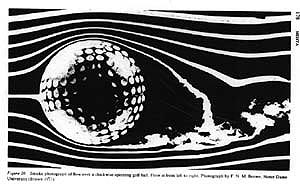
Golf Ball in flight
'Golf ball with backspin [rotating CW] with air stream going from left to right. Note that the air stream is deflected downward with a downward force. The reaction force on the ball is upward. This gives the longer hang time and hence distance carried.' - from Lift and Air Resistance by Tom Steiger, Department of Physics, University of Washington.


Simply put, this is what his research found: A rotating ball traveling through the air will create relatively low pressure, explained in Bernoulli's principle, on the side of the ball rotating the same direction as the air stream (faster air speed). High pressure will occur on the side of the ball rotating against the flow of air (slower air speed). Higher pressure (side rotating against the air stream), will induce premature laminar separation around the ball. Lower pressure air (side rotating with the air stream), has better adherence to the ball and deflects the air stream toward the area vacated by the high pressure separation, creating a 'wake.'

It is very much like turning the tiller on a boat to deflect the wake on the boat and alter its course. Turn the tiller to deflect water to the left boat causes the rear of the boat to move right. Deflect the water to the right, and rear of the boat turns left.

Since the golf terms of slice and draw are particular to the left or right-handedness of the golfer, we will simply use left or right to describe the deflection of the ball. If an imperfect hit on the golf ball causes the ball to spin clockwise, the ball will deflect air left causing the ball to curve to the right. If the hit imparts a counterclockwise spin, the ball will deflect air to the right causing a curve to the left. Top-spin, deflects air upward forcing the ball downward; while backspin will cause the ball to rise above its normal gravity determined parabolic arc.

The amount the ball will deviate from its initial trajectory is a function of the density of the air, the velocity of the ball, and the rpm of the spin on the ball.

The description of these principles is aptly named the Magnus Effect.

References:

Answered by: Stephen Portz, Technology Teacher, Space Coast Middle School, FL

Physlink.com published answer: "How do Transistors Work?"

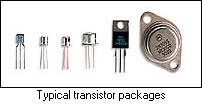
Transistors are composed of three parts ' a base, a collector, and an emitter. The base is the gate controller device for the larger electrical supply. The collector is the larger electrical supply, and the emitter is the outlet for that supply. By sending varying levels of current from the base, the amount of current flowing through the gate from the collector may be regulated. In this way, a very small amount of current may be used to control a large amount of current, as in an amplifier. The same process is used to create the binary code for the digital processors but in this case a voltage threshold of five volts is needed to open the collector gate. In this way, the transistor is being used as a switch with a binary function: five volts ' ON, less than five volts ' OFF.


TransistorsSemi-conductive materials are what make the transistor possible. Most people are familiar with electrically conductive and non-conductive materials. Metals are typically thought of as being conductive. Materials such as wood, plastics, glass and ceramics are non-conductive, or insulators. In the late 1940's a team of scientists working at Bell Labs in New Jersey, discovered how to take certain types of crystals and use them as electronic control devices by exploiting their semi-conductive properties.  

Most non-metallic crystalline structures would typically be considered insulators. But by forcing crystals of germanium or silicon to grow with impurities such as boron or phosphorus, the crystals gain entirely different electrical conductive properties. By sandwiching this material between two conductive plates (the emitter and the collector), a transistor is made. By applying current to the semi-conductive material (base), electrons gather until an effectual conduit is formed allowing electricity to pass The scientists that were responsible for the invention of the transistor were John Bardeen, Walter Brattain, and William Shockley. Their Patent was called: 'Three Electrode Circuit Element Utilizing Semiconductive Materials.'

Reference:

Answered by: Stephen Portz, Technology Teacher, Space Coast Middle School, FL
Physlink.com published answer: "How does a solar cell work? Is it possible to create one using simple lab apparatus?"

Solar cells (photovoltaics), use the energy from light photons to create electrical potential between two layers of silicon crystal. The atomic nature of silicon, with some added impurities, is what makes it all possible. The outer orbital electron shell of a silicon atom contains four electrons. Since it takes eight electrons to fill the electron shell, a silicon atom is continually looking for four electrons to bond with. This it finds by bonding covalently with other atoms of silicon forming a characteristic crystalline structure. Silicon atoms thusly joined are very stable and are not electrically conductive, but this is where the impurities come in. By 'doping' the silicon with substances such as phosphorus and boron, entirely different electrical properties are introduced into the silicon creating semi-conductive material.


For instance, when phosphorus joins with silicon, it creates an N-type semi-conductive material because phosphorus has five electrons in its outer shell. The silicon wants four of them but that leaves one electron hanging out by its lonesome and giving the molecule a negative charge. If boron joins with silicon, it creates P-type semi-conductive material (positive charge), as boron has three electrons in its outer shell. Even though silicon bonds with it, it leaves an electron 'hole,' where the molecule is positively charged and is still seeking an electron.

If layers of phosphorus impregnated silicon and boron-impregnated silicon are joined together with metal leads or conduits, an electrical potential can be created with some help from light. When light photons strike the phosphorus layer containing the extra electrons, those electrons can be sheered off and freed. When they are, they immediately recognize the potential in the boron layer and head that way. If a load (some work that you want to have done with electricity), happens to be connected in between these two layers where the potential has been created, then the migrating electrons are useful electrical current.

Solar cells are a wonderful alternative energy sources but have definite limitations. Since not all visible light is useful for this process, most of the sunlight energy can not be used to free electrons in the solar cells. Much of it is reflected or passes through not hitting the desired electron target. In addition, the electrical potential is very small and even with the most efficient solar cells; they must be chained together in large arrays to produce enough electricity to be useful. Because of the nature in which they produce their electricity, solar cells do experience a slight drop in effectiveness but they essentially never wear out. Then of course the most obvious problem: what do you do if the sun is not shining?

The nature work of the required to fabricate semi-conductive materials is probably beyond the realm of simple lab equipment. But many solar cell companies will give away broken cell fragments for the asking if you are looking for something to play with.

Also, if you are an educator, contact the Florida Solar Energy Center.

References:
http://www.nooutage.com/howsolar.htm http://www2.gasou.edu/chemdept/general/molecule/polar.htm
Answered by: Stephen Portz, Technology Teacher, Space Coast Middle School, FL

Physlink published answer: "Does the temperature of a football (or baseball, soccer ball, etc) affect how far it will travel when kicked/hit?"


Temperature can affect a couple of different variables in a ball to alter the distance it will travel from an impact. For inflated balls, the temperature can change the air pressure inside the ball giving an over inflated effect if it was warmed, or and under inflated effect if it was cold. (Have you ever tried dribbling a basketball without enough air in it?) The amount of air pressure then is directly proportional to the temperature of the air inside.


For solid core balls, like baseballs, golf balls etc' temperature has a similar effect on the ball but the mechanics are a bit different. Here, the characteristics of the material inside the ball are responsible for the bounciness of the ball.

A ball's bounciness is dependent on the elasticity of its constructed materials. The property of elasticity allows the ball to retain kinetic energy during a collision by having the ability to flex without breaking and then return to its original shape. This measure of a material's elasticity is called its coefficient of restitution.

An object with a low coefficient of restitution will lose a great deal of its kinetic energy in a collision through breaking or deforming, or through the generation of sound or heat. Compare the kinetic energy transmission through steel balls suspended on strings as they bounce back and forth in an example of a high coefficient of restitution. Now consider a lump of clay or a piece of glass in a collision, both materials having very low restitutional values ' they simply do not transfer energy well because they are not as elastic.

How does all this tie back into the temperature of materials? Temperature can also affect elasticity ' the colder a material gets, the less elastic it can be. Under cold conditions, the material can actually become more of an 'energy sink' ' absorbing energy rather than transferring it.

Both inflated and solid core balls rely on the principle of coefficient of restitution. A warmed, (over inflated) ball is more elastic than a cold, (under inflated) ball just as a solid core ball that is warm has more elasticity than an identical ball that is cold.

Answered by: Stephen Portz, Technology Teacher, Space Coast Middle School, FL

Physlink.com published answer: "How does a sailboat move upwind?"

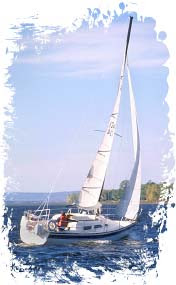
Since the early days of sailing, ships have undergone a continuous improvement in design so that today's modern sailboats, at casual glance, may give the appearance of having the ability to travel upwind (against the wind). In actuality, a sailboat can not travel directly into the wind but employs sailing technique known a 'tacking,' to zigzag across a headwind.


The shape of the sail and the hull of the boat are the major factors that have allowed sailboats to more closely approach the ability of sailing upwind. In the early years of sailing ships, the European ships had a square sail design. This design only allowed for sailing with a favorable wind ('before the wind, or wind on the quarter'). With trade expanding into the East, Europeans were exposed to triangular sails in use on small boats in the orient. It was observed that these triangular sails allowed for navigation using a half wind (wind at 90 degrees to the boat), which further increased the ship's maneuvering ability ' particularly in port, where ships previously were 'dead in the water' without a favorable wind. European vessels incorporated the triangular sails fore and aft of the mainsails for the purpose of navigating out to sea to catch the favorable trade winds for the square sails to utilize.

The use of triangular sails caught on as the sail shape of choice as other benefits to the design were realized. By using a triangular sail design and centerboard (overdeveloped keel), it was possible to travel against the wind using a technique known as tacking.

Tacking allows the boat to travel forward with a wind at right angles to the boat. The boat travels for a time at an angle toward its desired course (to the right for instance), then the captain swings the boom of the sail and tacts back across the desired course at an angle to the left in a zig-zag fashion. In this way, tacking allows the boat to use prevailing wind from many other angles than in earlier sailing methods.

Since the boat is dependent on the wind for propulsion, the strength of the wind and the area of the sail used to catch the wind obviously play a part ' but how does a wind at right angles to the boat allow the boat to move forward?

This is accomplished with a bit of vector mathematics. The wind is the large force vector in the equation. As the wind pushes at approximate right angles to the boat, the boat's large keel (underwater wing shaped centerboard), poses a very large drag force against the boat being pushed in the direction of the wind. Since the keel is aligned with the length of the boat, the boat really wants to travel forward, and the resultant thrust vector is in that direction.

The shape of the sail also provides forward thrust. As the triangular sail inflates with a wind it creates an airfoil shape. As subsequent wind passes around the sail (airfoil), negative pressure is induced out front of and on the leeward side of the sail. This in turn causes surrounding air to rush into the sail and propel the boat further. This sail/airfoil action is compounded, as the boat travels faster, the wind around the sail creates more negative pressure, causing the boat to travel faster causing more negative pressure and so forth.

Answered by: Stephen Portz, Technology Teacher, Space Coast Middle School, FL
https://www.physlink.com/education/askexperts/ae438.cfm 

Sunday, May 5, 2019

The Monkey on our Back - Teaching Students to be Effective Problem Solvers in an Information on Demand Society

The Monkey on our Back - Teaching Students to be Effective Problem Solvers in an Information on Demand Society

By Stephen Portz

From a TED-x Talk given at The WEISS School, May 3, 2019


As you can see I brought a friend with me today to help me with my talk.  You may be familiar with the idiom – “You have a monkey on your back.”


Having a monkey on your back means that you have burden to carry, a problem to solve, a challenging task at hand.  It comes from the notion that monkeys can be annoying creatures, especially when they are this close to you – they can pull your hair, scream in your ear, even bite you. Monkeys, like problems that need to be solved, are things we hope to be rid of, if even for a short time until the next problem arises.

Well, here is my monkey.  His name is Peekeroncheeto.  So, the monkey on my back, if you will, is to help you understand that recognizing, accepting, and dealing with the monkeys on your back is fundamental to your success in learning and in life.
As I work with my students in problem solving activities, I often think that we, as educators, take entirely too much responsibility for our students’ learning. 


You may be thinking, how is that possible? How can a teacher assume too much responsibility for student learning?  Teachers are entirely responsible for student learning, right?

While most people think this is true, after 30 years of teaching I have come to the conclusion that my greatest role and responsibility as a teacher is to create an environment that protects student self-discovery; not to be an information dispenser or worse yet, a rescuer from learning frustration.


Many teachers view student anxiety and temporary frustrations with problem solving as a teaching deficiency on their part.  But Leonardo Davinci, the famous engineer and artist, disagreed.  He suggested You cannot teach a man anything; you can only help them discover it for themselves.”


One challenge that students have in today’s information on demand society is that they don’t have to work very hard for many of their answers.  The monkey on their back is often easily dispatched with a simple Google search.  But what about problems that are unique and specific to a situation, require more creative problem-solving methods, or are problems that don’t even have a known solution yet?

Google’s Alexa, Amazon’s Echo, and Apple’s SIRI presently give us the Star Trek like experience of simply speaking our question into the air like Captain Picard, o the Star Ship Enterprise and having those questions instantly answered by these electronics built into our environment.

In the book entitled “The Next Fifty Years,” Roger Schank, a leading researcher of artificial intelligence and a distinguished career professor at Carnegie Mellon University, foretells how dealing with information, learning, and problem solving will occur in the future. 


Schank maintains, as information becomes so easily accessible, it becomes devalued, and knowledge as we presently view it, that is, having things committed to memory, will become totally unnecessary with information on demand. 

In a world such as this, the best and the brightest students will not be the ones who know the most stuff or score highest on the test. 
The best and the brightest students will be the ones that can ask important meaningful questions, questions that go beyond a computer’s ability to answer.

So how do we train our students to be prepared for a world such as this?

I found an account of an interaction between a master teacher and an apprentice learner which very powerfully illustrates the challenges of teaching and learning problem-solving in today’s information on demand society.

The apprentice had asked the master for help in solving a difficult problem, because, after all, they were the master teacher and supposed to know these things. 

The master teacher's response was highly instructive.  Speaking to the apprentice they scolded them a little – “You recognized there was a problem that needed solved but you, yourself, gave no thought to any possible solutions other than to ask me for help…if you want to grow in your understanding and ability, you must first study the problem out in your mind and arrive at some possible solutions on your own.  Only after you have done that should you come and ask me what I think.”

Many students are conditioned to ask for help the moment they are in a learning situation where they don’t know the answer.  They simply get frustrated.

Because of our information on demand, immediate gratification society, our students’ tolerance for frustration when solving problems has been steadily decreasing when at the same time, the need for this skill is increasingly important.
To be a good problem solver, you simply have to develop the capacity to endure learning frustrations. Because we will have a lot of them.


Peekeroncheeto helps me in times like this.  When a student is frustrated, it is useful to acknowledge the monkey on their back, to empathize, and talk with them about their points of frustration as well as ask them about their ideas of what they might try next.


The best strategy I have discovered for helping students with problem solving and “seeing what is in their mind” is jumpstarting the process by making them ask specific questions about the help they hope to get.  

Just saying "I need help, I don't understand, is not acceptable." Because that is just so much - YOU TOOK NO THOUGHT EXCEPT TO ASK ME FOR HELP.

Requiring students to specify their request for help does many things.  It can tell the teacher what they already understand and where they are at responsibility for ownership in the problem-solving continuum.  There are four levels of problem solving ability in this model, and you can tell where a student is on the continuum by the type of question that they ask you:


Level One: “I don’t understand.” – The student assumes no responsibility for the problem
Students in this stage want the problem solved for them.  They have little or no anxiety for solving the problem because they have not yet assumed ownership of it.  If they can get the teacher to assume ownership for the problem by making them feel guilty for THEIR lack of understanding, then maybe the teacher will take the monkey off their back and do the problem for them.  

It is my experience that students struggle at this point in the problem-solving process is often not a lack of understanding; it is a lack of assumed ownership, some resiliency in the face of frustration, and the mindset needed to look at the problem in different ways.

It is important to remember as their teacher that the answer is not the most important thing; but knowing how to arrive at an answer, that is the most important thing.
And be warned, you must not be afraid to walk away until a student is ready to assume ownership.  I tell them: “Go to where you don’t know… then, go to work."

Students at this point may really turn up the guilt as they want you to take away their monkey: “You are the TEACHER; you are supposed to help me!”  But they don’t want help, they want the answer.  They want the monkey off their back.

As problem solvers, we all want the frustration to go away, but fail to understand that the frustration is our greatest benefactor – it is what helps us develop the capacity for future problem-solving ability.

Level Two: “Can you give me a hint? In this stage, the student has started to accept their monkey, but they are not sure how to approach the problem yet.

The difference between this student and the Level One Student is problem ownership. This student is trying.   As the teacher, we can go back and reference past understanding and see if they can pick up on the strategies, identify patterns and processes.  Continue to coach creative thought and to consider the problem from different angles.

Level Three: “Can you help me, I tried this, and it didn’t work?” – The student has assumed most of the responsibility for the problem and has tried some ideas, but so far is unsuccessful.

Students in this stage of the problem have often made a wrong turn or misapplied a concept and just need to be redirected.  Make them go back over their work and think aloud to you.  It may be necessary to stop them in the error and remind them of the process: “Remember when I did this, I said to watch out for this?” and let them catch their own mistakes.  

You could ask, “What feedback are you receiving?”  What is the problem communicating back to you beyond the fact that this problem is not able to be solved in this way?  The problem does “talk” to us, if we will pay attention.  The problem will demonstrate what works, what kind of works, what doesn’t work, under what conditions and for what duration.  Edison really was saying this same thing when he was questioned about his failures with the incandescent light and gave his famous quote: “I have not failed. I have found 10000 ways that did not work.”  We have the opportunity to learn much more from our “failures” then we can from our successes. In fact, this is where the old adage “fail early, fail often” comes into play.

Level Four: What can I DO to make this work?” – The student has now internalized and taken full responsibility for defining the problem and solving it.  They are asking themselves the questions now; the teacher is not needed.

This is the ultimate goal for teachers as we prepare our students to be successful in an uncertain future.  A future where correct answers are cheap and easy to find, while good questions are much more prized and much more elusive. 
 
We can best help our students be prepared for the future by doing the following:

By using strategy of requiring our students to frame specific questions about the problem before receiving our help;

By making them accept ownership of the problem and think more about their thinking;

By understanding that learning frustration is an ally and not an enemy and not relieving our students of this learning frustration;

By using these strategies, we teach our students to be more resilient, more self-reliant, more resourceful, and more creative problem solvers.

But perhaps the most helpful thing of all in problem solving is having empathy for our learners.  Sometimes telling a story of a problem-solving frustration from your own life or the life of a great inventor is helpful.

Helping my students with their problem solving metaphorically is much like me taking the monkey from them and scolding the monkey for annoying the student.  “Peekeroncheeto, you are such an annoyance, why do you have to make things so difficult for my students?”

But in the end, I return the monkey to the student, because after all, it is their monkey ....their problem to solve.... their learning experience to have.

By doing these things our students CAN be successful in an information on demand society as we always remember: “If you show me the answer, I will never remember it.  If you let me discover the answer for myself, I will never forget it.”


Thank you.